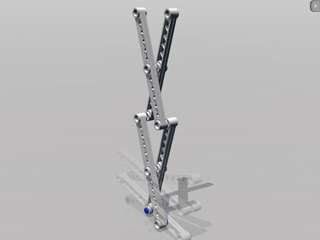
By using one of these methods or mixing them, you are able to produce
more complicated physics structures which
can consist of multiple of joints.
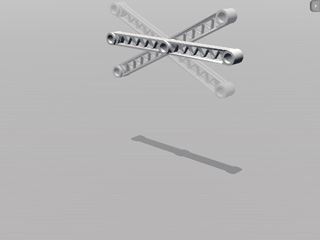
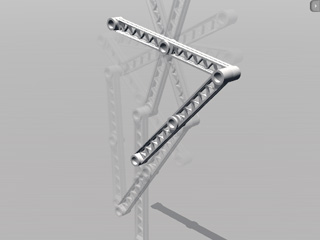
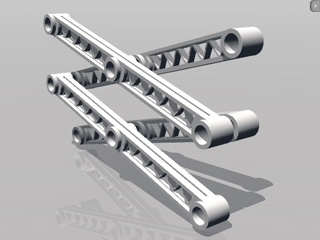
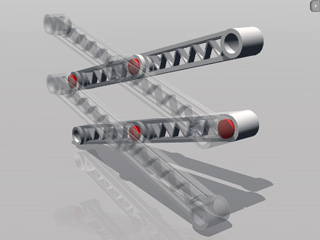
Here is a comparison on how you construct a raising platform using different approaches.
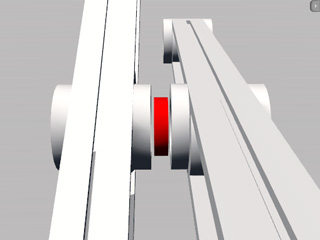
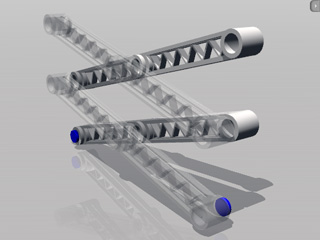
By using bolts, you can create a more complicated structure using multiple constraint techniques.
Directly Combining Objects - Using Pivots as Joints
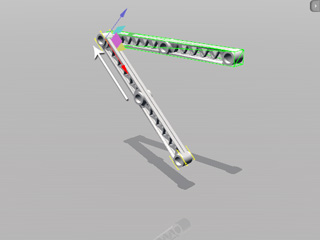
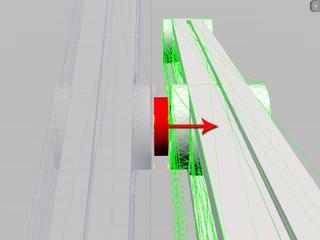
Because the constraints are always attached to the prop pivots, you may need to adjust the pivot position of the rigid bodies
once in a while so that the rotating result will work properly.
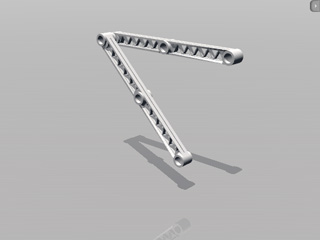
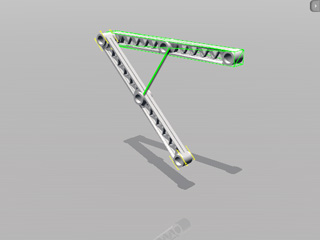
The individual pivots are at the centers of the two bars.
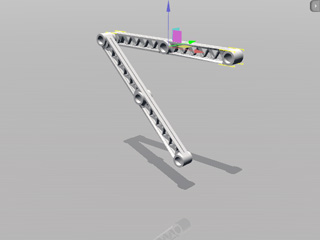
Apply a Hinge constraint to the upper prop in the example. Set its target to World so
that it will be pinned to where it is.
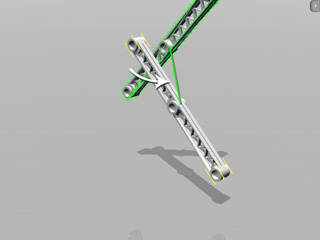
When this rigid body is hit by other physics objects, it will rotate around the local axis of its pivot.
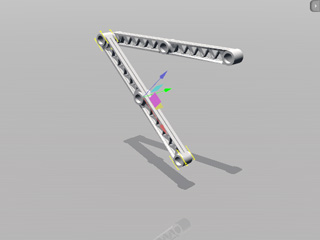
Apply a Hinge constraint to the lower prop in the example. Set its target to the upper prop. Its weight
will drag the upper prop to rotate.
The slant bar falls and causes the horizontal bar rotate.
Since the result may not be ideal, you can adjust the pivot of the lower prop to the joint part.
The upper prop will rotate on its defined axis while the lower one rotates because
of the eccentric pivot.
Note:
This method is suitable for a
chain-like structure. If you intend to create more complicated structures with multiple
joints on a single part, you may encounter difficulties because one prop can only have one pivot point.
Using Bolts (Intermediate Dummies) with Multiple Constraints
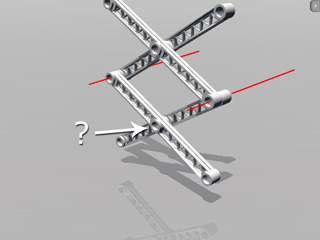
By using rigid bodies applied with multiple constraints as bolts, you can
easily integrate other components into a structure, especially the joint parts;
without adjusting the pivot of the parts in the structure.
Using the structure shown in the illustration above.
Apply a primitive prop with few polygons. Make sure its
pivot is at the middle-center.
Locate the prop to one of the joints between two bars of the structure.
Set it as a Dynamic rigid body. It will be
the intermediate prop applied with constraints.
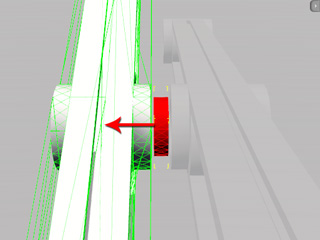
Apply the Hinge constraint to it. According to the Local Axis of it,
the Constraint Limit shall be set to (Z = Free) so the
hinge is able to rotate along the Z axis.
Pick the one of the bars (Dynamic rigid body) as the target.
Apply another Hinge constraint to it and pick the other bar as the target.
Repeat the same steps to create more bolts for the joints of the bars.
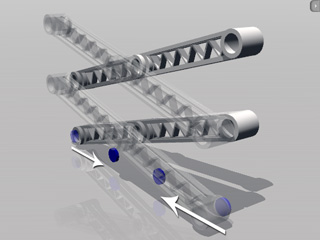
Apply another two bolts and set them as Kinematic rigid bodies.
Apply hinges to these two objects and individually pick the lower two bars as targets.
Set keys to the two kinematic rigid bodies so that they move close to each other.